How to plant Panicum
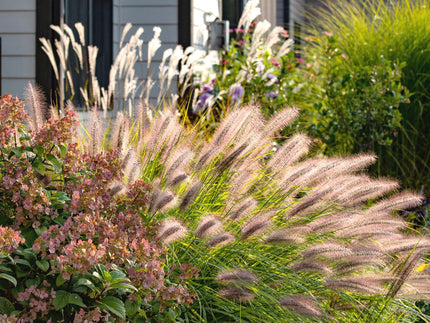
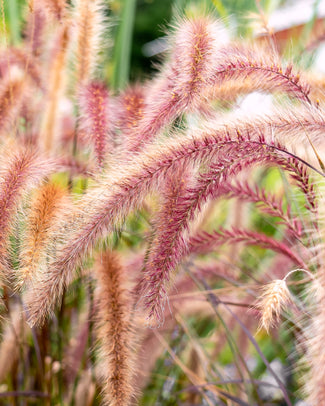
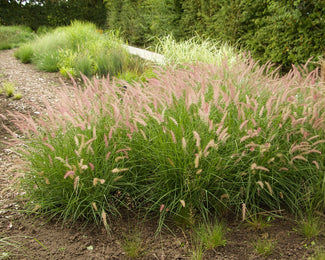
The slender, grey-green blades of Panicum form dense clumps that rise upwards before arching gracefully at the tips, often colouring to blood red and burgundy by late summer. Airy panicles of tiny flowers emerge on wiry stems to create a delicate haze that swirls gracefully with the touch of every breeze. If left intact over winter, the stems make a spectacular focal point when kissed with a sparkling frost.
This broad genus of ornamental grasses includes annuals and perennials, some evergreen while others are deciduous. They are generally hardy, and easy to grow. Although Panicum vary in size and appearance, they all share the same love of a sunny spot and fertile, well drained soil.
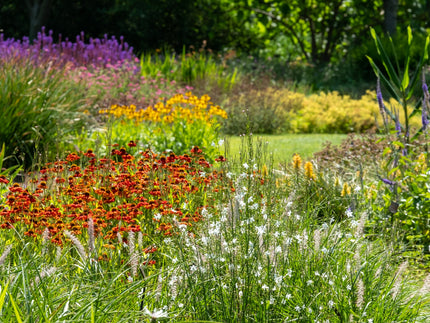
Panicum have a soothing presence, introducing texture and movement to planting schemes with effortless poise and grace. Dot them through borders as a backdrop for herbaceous perennials, or grow sweeping groups en masse for a dramatic, addition to prairie schemes.
How to plant
— Panicum are supplied as bare roots in spring for planting between February and May. They must be planted soon after delivery and can't be stored for long without light and moisture. If you can't plant on the day of delivery, remove the roots from the packaging within 1-2 days and place in a bowl of water outdoors to soak, then plant within a week.
— All bare root ornamental grasses should be potted up and grown on for some time prior to transferring into borders.
— Soak the roots in water for 3-6 hours prior to planting. Pot into temporary 2 litre (or 15-20cm diameter) pots, using a good quality multi-purpose compost with added grit to aid drainage.
— Plant with the roots fully submerged in the compost. There will be some old brown foliage from the previous year which is cut at around 10cm. This should be left exposed above the soil surface. New shoots will emerge from the base of these dried stems.
— Grow them on in a sheltered spot outside. They can be transplanted to borders after 2-4 months or once growth is established and the plants easily come out of the temporary pots with the soil held intact by the roots. When you see roots starting to emerge from the drainage holes in the bottom of the pot, it is an indicator that the plant is ready to be transplanted.
— When they’re ready to plant into the garden, choose a position with moist but well-drained soil. Dig over the area first to loosen the soil and remove any weeds. The area should be in full sun or very light shade.
— It is recommend to add multipurpose compost to the planting hole when planting, this will add nutrients to the immediate area and provide a soft medium for new roots to grow easily.
— Position your your plant into the hole and backfill with soil. Firm down after planting, ensuring the base of the stems remain level with the soil surface. Water thoroughly after planting.
— Panicum can also grow very well long-term in patio containers. If your ornamental grass is intended to grow and remain in a patio container, you can plant the bare root directly into the patio container with fresh multipurpose compost, there is no need to pot up and grow on first in this instance.
— As with all young plants, mark and monitor your newly-planted Panicum in the first year, check moisture levels regularly and remove any excess growth from neighbouring plants in the border to reduce competition.
— This perennial is fully hardy, tolerating temperatures down to around -15C. It doesn't require frost protection in most areas.
— Water-in after planting and keep hydrated when in growth, particularly during the first year. Once fully settled in, they are tolerant to quite dry conditions.
— Bare root grasses will have some dried foliage from the past year still intact. Panicum supplied in late spring will have some pale shoots which have already emerged. The shoots will soon start to green up after planting, watering and being exposed to daylight, or be replaced by new shoots. Additional shoots will also emerge through summer.
Aftercare
— Panicum are deciduous, naturally dying back in the autumn. New growth will emerge each spring.
— The faded stems stand well over winter and can be left intact until the spring. They make an attractive feature and provide good habitat for wildlife and pollinating insects.
— This perennial is fully hardy and does not require winter protection once it is well established. However, new plants may benefit from some shelter from heavy winter rainfall in their first winter.
— Cut back the old stems to 10cm above ground level in spring to encourage bushy new growth.
— Panicum will naturally form a clump once established. Overcrowded clumps can be lifted and divide in spring when necessary.
Read further general instructions about planting bare-root ornamental grasses




![[]](http://www.farmergracy.co.uk/cdn/shop/products/agapanthus-black-buddhist-1_325x.jpg?v=1575625838 "Agapanthus 'Black Buddhist'")
![[]](http://www.farmergracy.co.uk/cdn/shop/products/agapanthus-black-buddhist-4_325x.jpg?v=1627464050 "Agapanthus 'Black Buddhist'")