How to plant Dierama
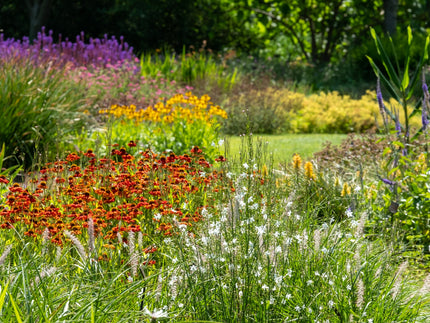
Few plants match the elegance and poise of this hardy cormous perennial. A heavenly display of nodding blooms dance and sway from midsummer to early autumn, perpetually in motion with the slightest breeze. The bell-shaped flowers dangle from arching stems, floating above clumps of slender, evergreen foliage with a textural, grassy appearance.
Commonly called Angel’s Fishing Rod, Dierama makes a prized addition to any plant collection. It blends effortlessly with grasses and creates a spectacular focal point in sunny borders and gravel gardens. This delectable beauty may take 2-5 years to flower, but your patience will be rewarded with a divine display!
With a reputation for slow establishment, it’s worth planting Dierama with care from the outset. This South African native needs a warm and sunny open spot, on moist, fertile and free draining soil, with shelter from the hardest frosts in winter. Once established, Dierama is a long-lived, no maintenance perennial that will become one of your most treasured garden plants.
How to plant:
— Dierama corms are supplied in spring for planting between February and late May.
— They are best planted within 6 weeks of delivery. If corms are received in May at the end of the planting season, they should be planted within a week of delivery. If you’re not ready to plant them as soon as you receive them, you can open the packets to let air circulate around the bulbs and store them in a cool, dry place. Don't store them for too long, they must be planted during spring in the same year that they're suppled to you.
— Dierama are hardy to around -5C when planted in a sheltered spot. It is not recommended to plant Dierama directly into borders as they are easily lost or accidentally dug up as dormant corms. Additionally, there are various other factors which can cause them to fail when planted directly into borders. They should be potted up into individual 9cm pots and positioned outside to grow on through spring, then transplanted to borders later in the season when they have established growth.
— When transplanting into borders, choose a sheltered, sunny position on fertile sandy or loamy soil that stays moist in summer and drains well in winter. Avoid cold or shaded locations, and soils that sit wet in winter.
— Dierama resents overcrowding from surrounding plants. Provide an open spot with no competition. Give plenty of space around them for clumps to increase in size over time.
— Dierama corms should be planted 5-7cm deep with any shoots facing upwards. Towards the end of the planting season, the shoots may already have started to grow – they should be planted at the usual depth with the shoots kept intact below the surface.
— Space the bulbs 5-10cm apart from each other.
— Cover back over with soil/compost. If the soil is very dry, it’s a good idea to water them in after planting to settle them. They will only require watering in spring if it is warm and the soil is dry.
— Dierama prefer a permanent position in open ground, however it is possible to grow them permanently in patio pots that will remain undisturbed each year. Select a tall pot with space for their deep root system. Use a good quality mix of gritty, peat-free multipurpose compost and John Innes number 2 compost.
Aftercare:
— Dierama is evergreen retaining its foliage all year round. In spring, trim away any leaves which have yellowed and died back leaving any healthy green foliage intact.
— Maintain an open position by trimming back neighbouring plants when necessary to prevent Dierama from being shaded or over-crowded.
— These corms should be left in the soil all year round and do not require lifting. Where possible, avoid disturbance as this can delay flowering.
— Once established, Dierama is reasonably drought tolerant and will usually only require water if it is very warm and the soil is dry. However flowering can be delayed if they are grown in very dry soil conditions.
— Dierama is tolerant of cold weather to around -5C, but it is recommended to apply mulch around young Dierama to help protect them from severe weather during their first winter.
— Leave Dierama corms undisturbed wherever possible. Overcrowded clumps can be lifted and divided in Spring however this may interrupt flowering for several years while the divided clumps re-establish.
![[]](http://www.farmergracy.co.uk/cdn/shop/products/agapanthus-black-buddhist-1_325x.jpg?v=1575625838 "Agapanthus 'Black Buddhist'")
![[]](http://www.farmergracy.co.uk/cdn/shop/products/agapanthus-black-buddhist-4_325x.jpg?v=1627464050 "Agapanthus 'Black Buddhist'")